Dental Implant Cost, Financing & Treatment Options Explained


Dental Implant Cost, Financing & Treatment Options Explained
Most implant ads show one number, and it almost never covers the full picture. A completed implant is a three-part system: a titanium post placed into the jawbone, an abutment connector, and a custom crown. Add in the 3D cone beam CT scan, any prep work your mouth needs, and the possibility of bone grafting if there has been bone loss at the site, and the real cost looks quite different from what the ad showed. In the St. Louis area, a single implant with healthy bone typically runs into the low thousands all in, but that number shifts depending on what your jaw actually needs.
The confusion around pricing usually comes from this: different practices quote different things. Some price only the surgery. Others leave grafting out of the conversation until you are already mid-treatment. The only number that means anything is one built around your specific scan, your bone levels, and a written treatment plan you can review before committing. That is exactly what Dr. Brandon Prior, Dr. Andrew Hartman, Dr. Sara Corrigan, and the team at 100 West Dental in Ballwin put together at your consultation.
If you'd rather just talk it through, call us at (636) 585-0100 or request a complimentary consultation.
What This Guide Covers
We built this as a real walkthrough, not a price list or a sales pitch. If you have questions about implants, this is where we try to answer them honestly. Here is what we cover:
- What a dental implant actually is and why teeth get lost in the first place
- How we figure out if you are a good candidate
- How to match the right solution to your situation, whether you are missing one tooth, a few, or a full arch
- What affects the price, how people typically pay, and what the process looks like from start to finish
- How to take care of your implant long-term, and the questions worth asking before you commit to any provider
What Are Dental Implants and How Do They Work?
A dental implant is not just one thing. It is a three-part system that rebuilds a tooth from the root up, not just the visible part above the gumline.
- The Post: a small titanium screw placed into your jawbone. Think of it as an artificial tooth root, and it is what makes implants fundamentally different from every other replacement option.
- The Abutment: a small connector piece that attaches to the top of the post and gives the visible tooth something solid to attach to.
- The Crown: the part you actually see. It is custom-made to match the shape and shade of your surrounding teeth, so it looks and functions like the real thing.
What makes the whole system work is something called osseointegration, which just means your jawbone gradually grows around and fuses to the titanium post over a few months. Once that happens, the implant becomes part of your jaw. That is where its strength comes from, and why it feels so natural when you bite down.
Am I a Good Candidate for Dental Implants?
The honest answer is: probably, but we won't know until we actually look. Most healthy adults with enough jawbone qualify, but that general statement doesn't tell you much about your specific situation. Candidacy isn't something that can be determined from a quick glance or a single flat X-ray. It takes a real evaluation.
Here are the four things that actually matter:
- Bone Volume and Density at the Site. The implant post needs enough solid bone around it to hold securely, and height, width, and bone quality all play a role. A 3D scan is the only way to see all three clearly. If the bone isn't quite there yet, a bone graft can rebuild the site before the implant is placed.
- Gum Health. If gum disease is active, it needs to be treated first. Placing an implant into an infected, inflamed environment is a setup for failure, so we address gum health before any surgical planning begins.
- Your Medical History. Things like uncontrolled diabetes, certain medications for bone conditions, autoimmune issues, or a history of radiation to the jaw can all affect how well you heal. None of these are automatic disqualifiers, but they shape the plan.
- Your Habits. Smoking reduces blood flow to healing tissue, which lowers implant success rates. Grinding or clenching puts stress on an implant that it wasn't designed to handle. Both are worth bringing up at your consultation, and there are ways to work around them.
A thorough workup includes a cone beam CT scan to measure your bone in three dimensions, a full review of your medical history and medications, a periodontal check, and an open conversation about anything that could affect healing.
Single Tooth, Multiple Teeth, or Full Arch: Finding the Right Solution
The number of teeth you are replacing changes everything: the treatment plan, the timeline, and the total cost. Here is a plain-language breakdown of each scenario so you can walk into your consultation already knowing where you likely stand.
One Missing Tooth
This is the most straightforward case: one titanium post placed into the jawbone, one connector piece (called an abutment), and one custom crown on top. It is actually the scenario implants were originally designed for, and it tends to be the most predictable in terms of cost and healing. That said, bone quality and whether any grafting is needed can still affect the plan, so a proper evaluation always comes first.
Several Missing Teeth
If you are missing a few teeth in a row, you might assume you need one implant per tooth, but that is often not the case. Two well-placed implants can support a bridge that spans the gap, which brings the cost per tooth down considerably. Whether that approach works depends on the spacing, how much bone is available, and the health of the teeth on either side of the gap.
A Full Arch
Replacing an entire upper or lower row of teeth does not require an implant for every missing tooth. All-on-Four and similar approaches use just a handful of implants, sometimes angled strategically to make the most of the bone that is available, to anchor a full set of fixed teeth. The price here reflects the complexity of the surgical planning and the custom prosthetic, not a simple per-tooth calculation.
Implant-Supported Dentures
This is a middle-ground option for people replacing a full arch who want something more stable than traditional dentures but are not ready for a fully fixed restoration. Instead of relying on suction or adhesive, a removable denture snaps securely onto a few implants. It is typically less expensive than a fixed full-arch solution, it helps slow the bone loss that comes with conventional dentures, and it eliminates most of the slipping and discomfort people associate with dentures.
What Dental Implants Cost in the St. Louis Area and Why the Range Is So Wide
If you have ever seen an implant advertised for a price that seemed surprisingly low, it is probably because that number only covers one piece of the puzzle. A completed implant is a multi-step treatment, and the final cost depends on what your mouth specifically needs. Here is what actually goes into that number:
- The Three Components. Every implant has three parts: the titanium post that goes into the bone, the abutment that connects it to the tooth above, and the custom crown you actually see and chew with. Each part has its own cost.
- Imaging and Diagnostics. Before anything is placed, we take a 3D cone beam scan of your jaw. This shows us your bone levels, where your nerves run, and how your sinus sits, so placement is precise and not left to guesswork.
- Pre-Treatment. Sometimes the mouth needs to be prepared first. That might mean an extraction, gum disease treatment, socket preservation, ridge grafting, or a sinus lift. This is the part of the estimate that varies the most from person to person.
- Number of Implants. Replacing one tooth looks very different from replacing several or a full arch. More implants mean more surgical time, more components, and a more involved plan.
- Materials and Complexity. The type of crown, the implant system used, and whether your restoration is fixed or removable all affect the price. The anatomy of your jaw matters too, since working near a nerve or sinus requires more careful planning.
- Sedation. Some patients prefer oral conscious sedation to stay relaxed during the procedure. Others are perfectly comfortable with just local anesthetic. Either way, we will talk through your options beforehand.
Yes, implants cost more than bridges or dentures, and there is a real reason for that. You are paying for a surgical procedure, advanced 3D planning, multiple appointments, and a restoration that actually bonds to your jawbone the way a natural root does. It is a bigger investment upfront, but it is also the only option that replaces the tooth from the root up and keeps the bone underneath healthy over time.
What to Expect: The Implant Process from Consultation Through Recovery
For most people, the unknown is the scariest part. Once you know what actually happens and in what order, the process feels a lot more manageable. Here is how a typical single-tooth implant case unfolds.
1. Planning and Imaging
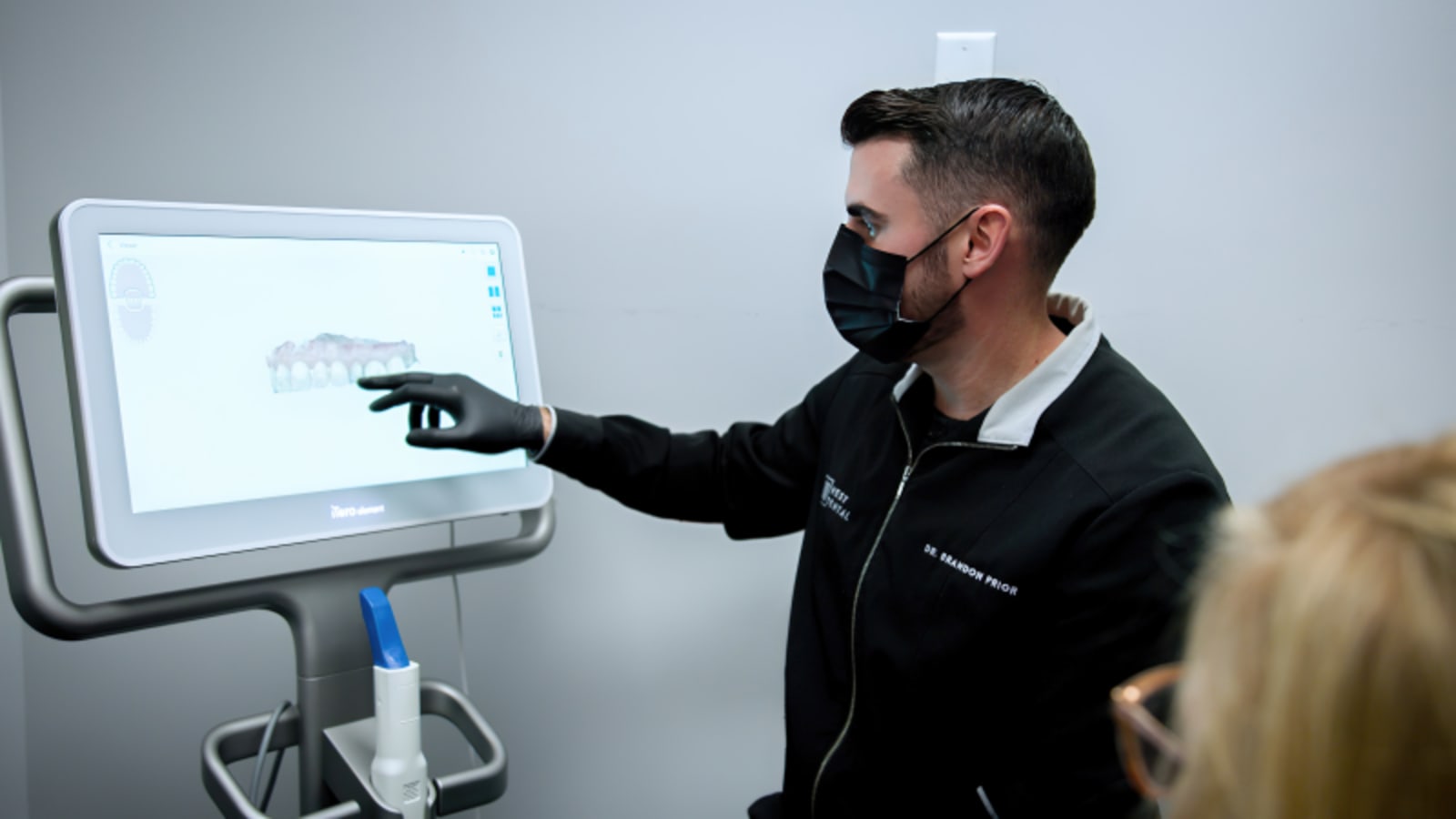
Before anything else, we take a cone beam CT scan, a 3D image of your jaw that shows your bone depth, nerve location, and sinus position. This is what lets us plan exactly where the implant goes before we ever touch anything. It also tells us upfront whether any bone grafting is needed, so there are no surprises mid-treatment.
2. Extraction and Site Preparation, If Needed
If a failing tooth still needs to come out, we often do socket preservation grafting at the same appointment. This fills the empty socket with graft material to keep the bone from collapsing inward while it heals, which protects the space the implant will eventually go into. If grafting is needed, you will have a few months of healing time before the next step.
3. Placing the Implant
This is the surgical step, and it is usually much easier than people expect. The titanium post is placed into your jawbone under local anesthetic, and most patients say it felt less intense than a tooth extraction. If you would rather be more relaxed throughout, oral conscious sedation is available. The appointment itself is typically shorter than you would think.
4. Healing and Integration
Over the next few months, your jawbone gradually grows around and bonds to the titanium post in a process called osseointegration. Think of it as your body accepting the implant as part of the jaw. While that is happening, you will have a temporary restoration so you are not walking around with a gap. Life goes on pretty normally during this phase.
5. The Final Crown
Once we confirm the implant has fully integrated, we attach the abutment, the small connector piece, and place your custom crown on top. It is shaped and color-matched to blend in with the teeth around it. By the time you leave that appointment, you can chew on it like a normal tooth.
Caring for Your Implants: Aftercare, Bite Health, and the Long Game
Taking care of an implant day to day is pretty similar to caring for a natural tooth, with one key difference. An implant cannot get a cavity, so the main thing to protect long term is the gum and bone around it.
- Brush and floss every day, and pay a little extra attention right at the gumline where the implant meets your gum. That is where plaque tends to sneak in.
- Keep up with your regular cleanings and checkups. We keep an eye on the gum tissue and bone around the post at every visit, so if anything starts to change, we catch it early when it is easy to address.
- Wear a night guard if you grind or clench. That kind of repeated pressure is hard on the implant, the crown, and the bone holding everything in place. Grinding is often connected to airway issues or poor sleep quality, so we ask about both and we offer sleep apnea and TMD treatment as part of the same conversation.
- Take care of your gums everywhere, not just around the implant. There is a condition called peri-implantitis, which is essentially gum disease around an implant, and it is the most common reason implants fail years down the road. Our gum disease treatment is designed to get ahead of that before it ever becomes a threat to your implant.
If you have a full-arch restoration, the routine is slightly different. There is a small gap beneath the prosthesis that needs to be cleaned daily. A water flosser works well for this, and we will show you exactly how to do it when we deliver your final restoration.
Questions to Ask Before You Commit to Implant Treatment
You don't need a dental degree to tell the difference between a thorough evaluation and a quick upsell. A few honest questions go a long way. Here's what we'd encourage you to ask any provider you're considering:
- Did you take a cone beam CT scan, or are we working from a regular X-ray? A standard flat X-ray only shows height, so it cannot tell you how wide the bone is or exactly where your nerve sits. If a provider said you're a good candidate without a 3D scan, it's fair to ask what that was based on.
- How Much Bone Do I Have at This Site, and Can You Walk Me Through It? A good provider will pull up your scan and show you exactly what they're seeing. You shouldn't have to take their word for it.
- Will I Need a Bone Graft, and If So, What Does That Add in Time and Cost? This should never be a surprise mid-treatment. If grafting is needed, you deserve to know upfront, before you've committed to anything.
- Can I Get a Written Treatment Plan with the Costs Broken Down? Verbal estimates have a way of shifting once you're already in the chair. A written, itemized plan protects you and sets clear expectations on both sides.
- What Are My Other Options, Including Waiting? A provider who can honestly tell you when a bridge or denture makes more sense is one you can trust when they do recommend an implant.
- What Happens If the Implant Doesn't Take, and Is Anything Covered If That Happens? Implants have a high success rate, but it's a fair question. Knowing the answer ahead of time tells you a lot about how a practice stands behind their work.
- What Does Keeping This Implant Healthy Look Like Long Term, and What Does That Cost? Implants need regular monitoring just like natural teeth. Understanding what follow-up care looks like helps you plan for the full picture, not just the procedure.
- How Much Experience Do You Have with Cases Like Mine? Placing an implant, designing the crown, and managing a full-arch case are genuinely different skill sets. It's worth asking about each one separately, especially if your situation is more complex.
Ready to Get a Real Number for Your Situation?
This page can give you a solid foundation, but the only number that actually matters is the one built around your mouth, your bone, and your specific situation. When you come in, you will not leave with a ballpark. You will leave with a written treatment plan that lays out the timing, the steps, and the cost, clearly, line by line.
If there is more going on than just a missing tooth, whether it is your gum health, your bite, or how you are sleeping, we will look at all of it. Dr. Brandon Prior, Dr. Andrew Hartman, and Dr. Sara Corrigan all work together here in Ballwin, so everything gets handled under one roof by a team that already knows your full picture.
Your consultation is complimentary, and there is no pressure to commit to anything. Call us at (636) 585-0100 or request a visit online. We are on Manchester Road in Ballwin. Come see us.
