Dental Implant Cost in St Louis Missouri: What Patients Should Expect


Why Nobody Can Quote You an Implant Price Over the Phone
If you've been searching for what dental implants cost in the St. Louis area, you've likely noticed the numbers vary widely, and most come with an asterisk. That's not a bait-and-switch. It's because a dental implant isn't one product with one price tag. It's a small system of parts and steps, and which parts you need depends on what's happening in your mouth right now, particularly your bone and your gums. If gum disease is part of the picture, treating that infection comes before anything gets placed.
Dr. Brandon Prior and the team at 100 West Dental in Ballwin talk about implant cost every week with patients from across the greater St. Louis metro, and the conversation always starts the same way: what are we replacing, and what has to happen first? This article walks you through the pieces that make up the number, where costs tend to rise, and what a real estimate should look like. If you'd rather talk it through with someone, call us at (636) 585-0100.
What to Know First
- An implant fee is usually three separate things bundled together: the implant post, the abutment that connects it, and the crown or bridge on top. Some quotes include all three and some don't, so always ask which you're looking at when you review a dental implant estimate.
- Bone grafting, sinus lifts, and extractions are the most common reasons a quote comes in higher than expected. Whether you need bone or sinus grafting can only be determined with a 3D scan, not a flat X-ray.
- Replacing a full arch costs more than a single tooth, but the math isn't proportional. Four implants can support an entire arch of teeth, which is the approach behind All-On-Four treatment.
- Dental insurance often covers pieces of implant treatment rather than the whole thing, and annual maximums limit what's available in a given year. You can see which plans we accept on our Be Our Guest page.
- Before you commit to anything, you should have a written treatment plan with itemized fees laid out by phase.
The Three Parts You're Actually Paying For
When people compare implant prices, they're often comparing different things. Here's what makes up the restoration of a single tooth.
The implant post
This is the titanium fixture placed into your jawbone, taking the place of the tooth root. Over the following months, your bone grows tightly around it in a process called osseointegration, which is what makes an implant feel solid rather than removable. The fee reflects the planning, the surgery, and the hardware. If there isn't enough healthy bone to hold the post, bone or sinus grafting may be needed first, and that's a separate procedure with its own fee.
The abutment
The abutment is the small connector that attaches to the post and sits just above the gum line. It's what the final tooth seats onto. Some are stock components, while others are custom-milled to match your gum contours and bite angle. Custom abutments cost more, but they produce a better-looking, better-functioning result, especially in a visible area like a front tooth.
The crown or prosthesis
This is the part you see and chew with. For a single tooth, that's a crown. For several missing teeth in a row, it may be an implant-supported bridge. For a full arch, it's a fixed prosthesis anchored to multiple implants, which is the approach used in All-On-Four and implant-supported denture cases. Materials and lab work vary, and so does the cost.
When someone quotes you a low per-implant number, it's worth asking whether that includes the abutment and crown, or just the post. Two quotes that look thousands of dollars apart can end up much closer once you line up what's actually included.
Where Costs Genuinely Rise: Bone, Gums, and Timing
An implant needs enough healthy bone around it to stay stable for decades. When a tooth has been missing for a while, the bone in that spot shrinks, because bone maintains itself in response to chewing forces it is no longer receiving.
Bone grafting
If there isn't enough bone width or height, we place graft material to hold the space while your own cells grow in and remodel the site. Bone grafting adds cost and time before the implant can be placed. When it is needed and skipped, that is typically how implants fail down the road.
Sinus grafting
In the upper back jaw, the sinus cavity sits close to where the tooth roots used to be. When there isn't enough vertical bone between the ridge and the sinus floor, a sinus graft creates the room needed for an implant of adequate length. It appears as its own line item on the estimate.
Extractions and existing infection
If a failing tooth is still in place, it needs to come out first. An implant placed into an infected or inflamed site is unlikely to integrate properly, so periodontal treatment sometimes comes first in the sequence and appears in the plan as its own phase.
How we determine any of this
A flat X-ray alone cannot give us the full picture. We use Cone Beam 3D imaging to evaluate bone volume, density, nerve position, and sinus anatomy in three dimensions, along with a digital intraoral scan. That is how we identify whether grafting is needed before you are ever sitting in the chair, rather than discovering it during surgery.
If you have been told you are a candidate after a quick look and a two-dimensional X-ray, it is worth asking what the 3D scan showed.
Single Tooth, Multiple Teeth, or a Full Arch
The scale of treatment is the biggest driver of the total, but the math isn't as simple as multiplying by the number of missing teeth.
One missing tooth
A single dental implant with an abutment and crown is the most straightforward version of this treatment. One thing that sets it apart from a traditional bridge: we don't have to grind down the healthy teeth on either side to anchor anything. Your surrounding teeth stay exactly as they are.
Several missing teeth
You don't necessarily need one implant per tooth. Two implants can support a three-unit bridge, for example. The planning question is where to place them for the best force distribution, which is why the number of implants is often fewer than the number of teeth being replaced.
A full arch
Replacing all the teeth on the top or bottom is the largest investment, and it involves both a surgical phase and a prosthetic phase. All-on-4 and implant-supported dentures use a small number of strategically positioned implants to carry a full set of teeth, which is generally less expensive than placing an individual implant for every tooth. Fridays at our Ballwin office are reserved specifically for larger cases like full-mouth rehabilitation, so that work gets the uninterrupted time it deserves.
What Insurance Typically Does and Doesn't Cover
We accept many major insurance plans, including Aetna, Delta, Cigna, MetLife, and Guardian. You can see the full list on our Be Our Guest page. Whether implants are covered depends on your specific plan, and coverage is usually partial. A few things worth knowing before you call your carrier:
- Some plans cover the crown but not the surgical placement, or vice versa. Extractions and grafting may fall under different benefit categories than the implant itself.
- Annual maximums are typically modest relative to implant treatment, so spreading a multi-phase plan across two benefit years can help you make better use of available coverage.
- Waiting periods and missing-tooth clauses appear in some policies and can affect what you're eligible for.
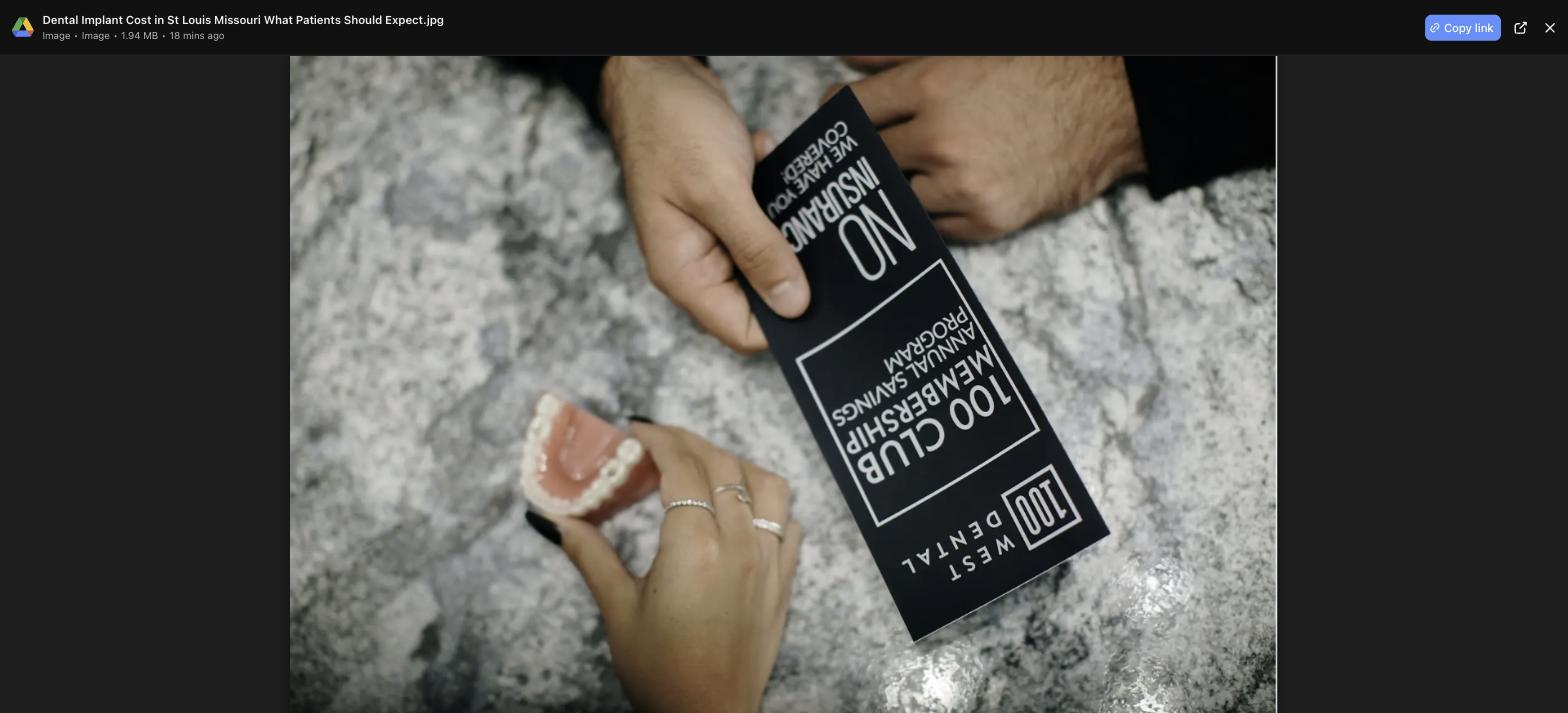
If you don't have dental insurance, ask us about the 100 Club VIP Membership, our in-house prepaid plan with no deductibles or yearly maximums that includes 15% off general treatments. Our team will help you understand what your plan is likely to contribute before treatment starts, so your estimate reflects your actual out-of-pocket cost.
Why the Cheapest Path Isn't Always the Cheapest Path
Implants are built to last a long time, which means the real cost isn't what you pay on the day of the procedure. It's what you get out of it over the years. A well-planned dental implant that integrates properly and sits in a stable bite can function for decades. One placed without adequate bone, or into a bite that puts the wrong kind of pressure on it night after night, can fail and require removal, grafting, and replacement. That's a much harder road than taking the time to do it right from the start.
That's why Dr. Brandon Prior looks at the full picture for every patient, not just the gap where the tooth used to be. He evaluates periodontal health and infection risk, biomechanical risk to your remaining teeth, how your bite distributes force, and the esthetic outcome. A missing tooth is rarely an isolated event. Understanding why it was lost in the first place usually tells us what needs to be addressed so the replacement holds up for the long haul.
Waiting also has a cost. Bone shrinks in an empty site over time, neighboring teeth can drift, and opposing teeth can shift out of position. A case that's relatively simple today may need grafting in a few years if nothing is done. If you'd like to talk through your options, give our Ballwin office a call at (636) 585-0100.
What a Real Estimate Should Include
Not knowing what something will cost is one of the most common reasons people put off implant treatment longer than they need to. A thorough implant consultation should leave you with a clear picture, not more questions. Here's what that looks like:
- Itemized fees for each component and procedure, not a single lump sum.
- A phased sequence showing what happens when, including healing intervals, so you can see how the investment spreads over time.
- Your 3D imaging findings explained in plain language, including whether grafting is needed and why.
- Alternatives where they exist, including what a bridge or a removable option would involve.
- An insurance estimate based on your actual plan. If you don't have coverage, ask us about the 100 Club VIP Membership, our in-house prepaid plan with no deductibles or yearly maximums that includes 15% off general treatment.
If you've already been given a number somewhere else and aren't sure what it includes, bring it along.
Common Questions About Implant Cost
Why is a full-arch case less than four separate implants per side?
Most of the savings come from the restoration side. A full arch is one lab-fabricated prosthesis with a handful of connecting components, rather than a dozen individual abutments and crowns, each carrying its own lab fee and its own seating appointment. You can learn more about how All-On-Four dental implants are structured.
Does bone grafting always add months to treatment?
Not always. Minor grafting at the time of an extraction can sometimes happen during the same visit as implant placement. Larger reconstructions do need healing time before the implant goes in. Your 3D scan tells us which situation applies to you, so there are no surprises once treatment begins.
Is a cheaper implant brand a bad idea?
The variables that matter most are planning, surgical technique, and how the final bite is designed. Established implant systems also come with long-term clinical documentation and readily available replacement components down the road, which is worth considering if anything ever needs attention years from now.
Can I spread treatment out?
Often, yes. Phasing treatment across benefit years or around your own schedule is a normal part of how we plan care here. We will map it out with you so it feels manageable rather than all-or-nothing.
Let's Look at Your Situation Specifically
A real number comes from a real evaluation: 3D imaging, a look at your gums and bite, and a conversation about what you want your smile to do for the next twenty years. That is what an implant consultation at our Ballwin office is for. Call (636) 585-0100 and we will get you scheduled with Dr. Brandon Prior.
